
Purpose
The QBCC building certifier audit program offers direct engagement for education and advice on certifier duties and responsibilities under the Building Act 1975.
Audits have the potential to uncover substandard behaviour within the industry, safeguarding builders, homeowners and certifiers alike.
Where an audit has identified issues, we may take regulatory action to ensure the safety of owners/occupiers and also uphold the standard of the certification industry.
Officers of the QBCC’s Certification Unit may conduct audits on building certifiers licensed in Queensland. Section 133 of the Building Act 1975 (Building Act) provides the regulatory instrument for QBCC’s to carry out audits.
While conducting the audit, we may work with the building certifier to educate them on their responsibilities. This helps to support building certifiers in maintaining a high level of compliance and professional standard.
In general, the program undertakes a review of the building certifiers functions through three areas:
- building certifier’s assessment,
- inspectorial, and
- administrative processes.
These audits may also assess whether the certifier’s functions have been carried in accordance with relevant statutory requirements, for example:
- Building Act 1975
- Building Regulation 2021 (Building Regulation)
- Planning Act 2016
- Queensland Development Code
- Local planning instruments
- Building Code of Australia (BCA)
- Australian Standards
- Code of conduct for building certifiers
In addition, QBCC Officers may also check:
- decision notices imposed with conditions;
- compliance with the BCA or any other building assessment provision;
- administrative processes, including document lodgement and recordkeeping;
- certificates of inspection, final inspection certificates and certificates of occupation; and
- competent person registers.
Audits may review all areas of interest, or focus on particular key areas of the highest risk of harm (for example Queensland Fire Department referrals for buildings over 500m2), or where intelligence suggests there is non-compliance currently prevalent in industry.
We carry out two types of audits:
- Assessment audits (also known as an administration or desk top audit) - assessment audits specifically involve the auditing of building certifier’s files (approval and inspection documents) and their administrative procedures to identify compliance with legislative requirements. These audits do not require a site visit.
- Technical audits (also known as a site audit) - technical audits specifically involve conducting an inspection on-site of building work under construction. This audit relates to building certifier approval documentation as required under Section 133 of the Act. Audits are conducted on all classes of buildings.
As noted, building certifiers can expect to be audited at least once in each 3-year period. However, other criteria may be considered for additional or prioritised audits to occur.
Audit selection is based on criteria including:
- Risk
- Location
- Random selection
- Licensee history, including recently being granted a building certifier’s licence in Queensland
The audit program is focused on identifying issues associated with building certification functions. It also aims to promote the obligations that building certifiers have to comply with regulatory requirements and to minimise harm or loss to the community that may happen as a result of non-compliance.
What happens next?
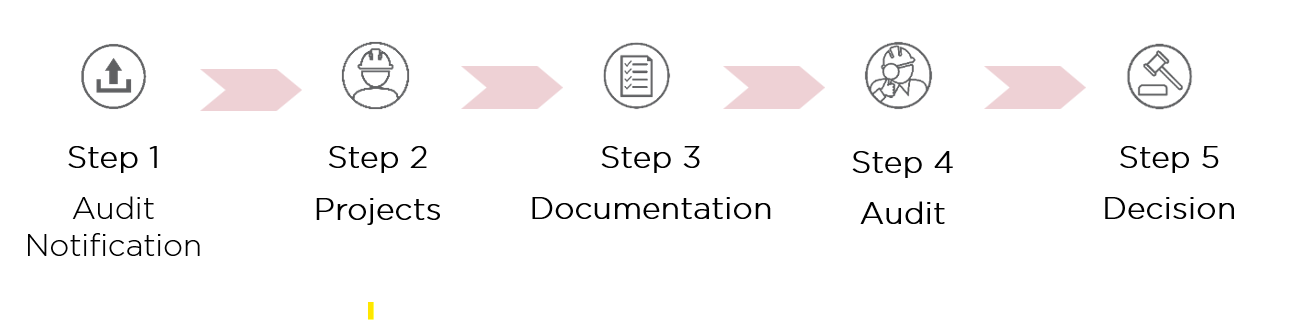
As outlined below, audits are managed with a five step process designed to ensure fairness, transparency, and compliance with the Building Act 1975.
-
The first step in the Audit process begins when you're notified by QBCC that your work as a licensed building certifier will be audited.
There are two types of audits: Assessment and Technical
In an Assessment Audit, you will be informed that you have been randomly selected, and you will be asked to provide a list of all the projects you have certified over the past six months.
For a Technical Audit, the review focuses on a specific building site, and you will receive a request for all documentation related to that particular project.
Either way, this initial notification is your official alert to begin gathering the required information for the Audit.
-
During Projects (Step 2) of the audit process, we shift our focus to verifying project documentation to ensure compliance with regulatory requirements.
The approach varies slightly depending on the type of audit you are undergoing:
- For Assessment Audits: After receiving your list of projects, the QBCC Certification Unit will select specific sites for audit. We will then request documentation relevant to those selected projects
- For Technical Audits: During this phase, we will confirm that you have submitted all the documentation we requested in the Audit Notification (Step 1) for the specified project.
This step is critical to streamlining the audit process and ensuring accuracy. Always review your documentation beforehand to avoid delays.
-
Once we receive your documents, a QBCC Auditor will assess the documentation and determine if we have all the information we need to progress to audit (Step 4).
If no further information is required, you will progress to audit.
-
For both assessment and technical audits we look at your responsibility in administering the engagement and inspection stages of the certification process. Your compliance and cooperation with an Audit are required under Sections 195 and 201 of the Building Act 1975.
Our Audit Program supports building certifiers through education and advice on their duties under the Building Act 1975. If issues are found, we will provide guidance and work with you to resolve them. We may also take disciplinary action to protect site owners/occupiers and maintain industry standards.
The audit will consider (but is not limited to):
- How the engagement was administered
- Inspection stages
- Queensland Fire Department referrals for building approvals over 500m2 (where applicable)
Audits may take significant time and contacting for updates may slow the process. No exact timeframe can be given because it depends on the complexity of the project. To help us progress your case more quickly, please wait to be contacted.
-
After conducting an Audit, we must decide whether or not the building certifier has engaged in unsatisfactory conduct or professional misconduct.
Once the Decision is completed, we will provide you and your employer or appointer (if applicable) with an Information Notice outlining the reasons for the decision and review rights in relation to the decision under Section 204 of the Building Act 1975.
Essential tips for certifiers—a few reminders
- Maintain competent person records: It is important to keep accurate records of competent persons in accordance with the Building Regulation. This documentation plays a significant role in ensuring the quality and safety of building practices.
- Validate approved forms: Before issuing stage inspection certificates and final inspection certificates, double-check that all information documented on the approved forms is correct. This diligence helps avoid future disputes and ensures that all procedures are followed properly.
- Conduct thorough searches: Upon receiving an application, it is essential to perform comprehensive searches to identify any existing infrastructure, registered easements, or covenants affecting the site. This foundational step helps prevent future complications and ensures all relevant factors are considered in your assessment.
- Update decision notices: Make it a practice to revise the conditions in decision notices to align with the latest National Construction Code parts, applicable Australian Standards, and mandatory forms. This ensures compliance and reflects current building regulations.
- Relevance of approval conditions: Ensure that the conditions attached to approvals are directly relevant to the classification type of the building in question. This alignment is crucial for the appropriateness and effectiveness of the conditions set.
- Remind builders of obligations: Include an advisory condition in the decision notice that reminds builders of their responsibilities to notify the building certifier at various stages of the construction process, as stipulated by the Building Regulation .
- Document appeal rights: Always include a clear outline of full appeal rights on the building certifier’s decision notice. This transparency is vital for maintaining trust and understanding among all stakeholders involved in the building process.
- Record decision rationale: It’s imperative to clearly articulate the reasons behind your decisions, following the code of conduct for building certifiers. The QBCC recommends utilising and retaining an assessment check-sheet to maintain an organised record.